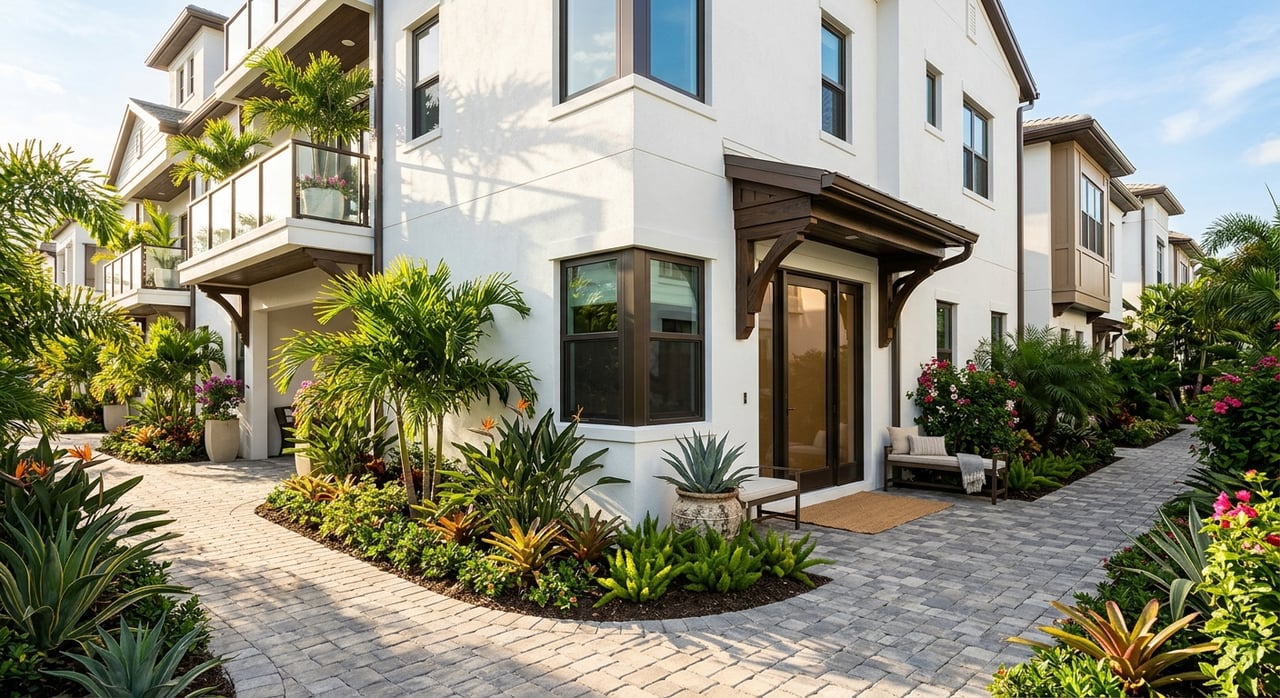
Wondering whether a townhome or a single-family home makes more sense in Estero? You are not alone. In a village where many buyers are balancing lifestyle, maintenance, amenities, and monthly costs, this choice can shape how easy your day-to-day life feels for years to come. The good news is that Estero offers strong options on both sides, and once you know what to compare, the decision gets much clearer. Let’s dive in.
Estero is a relatively compact village with 36,939 residents, 25,854 households, and about 30 square miles, according to the Village of Estero. The village also includes 69 communities, which gives you a wide range of home styles and amenity packages to consider.
The Village of Estero’s planning framework recognizes several residential types, including multifamily, townhome, villas, mid-rise, and single-family homes. That matters because in Estero, attached-home options may be marketed under different labels. A property called a villa or low-maintenance home may function a lot like a townhome, so you need to look beyond the name and focus on the ownership structure, fees, and maintenance responsibilities.
A townhouse is generally a side-by-side attached housing unit. In practical terms, that usually means you share at least one wall with a neighboring home and have a smaller lot than you would with a detached property.
For many Estero buyers, the biggest appeal is convenience. If you want less exterior upkeep, fewer yard chores, and a more lock-and-leave lifestyle, an attached home can be a strong fit. That can be especially helpful if you travel often, split time between homes, or simply want a shorter weekend to-do list.
Townhome or attached-home living often works well when you want:
In Estero, that low-maintenance appeal shows up clearly in communities with resort-style amenities. Buyers often weigh not just the home itself, but the overall lifestyle package that comes with it.
Single-family homes are typically detached homes and usually offer the most privacy and space. In Estero, that often translates to more separation from neighbors, more flexibility with outdoor living, and a better fit if you want a bigger lanai, more yard space, or room for a pool.
If you like having more control over your property, a single-family home may feel like the better long-term choice. You may have more space for entertaining, storage, parking, and outdoor customization, depending on the community and lot.
Single-family living often makes sense when you want:
In Estero, many detached-home communities compete as much on amenities as on the homes themselves. That means you can often find the resort-style features you want without giving up the extra space that comes with a detached property.
One of the best ways to understand the difference is to look at communities where buyers can compare attached and detached options in a similar setting.
Verdana Village is a useful local example because it includes both attached and detached choices within the same master-planned community. Lennar shows the community as actively selling from $355,999 to $648,999, with villa homes starting at $355,999 and $365,999. Pulte’s single-family homes in the same broader community start at $399,990+.
Amenities at Verdana Village include indoor pickleball, indoor basketball, tennis, a fitness center, a café and ice cream parlor, a restaurant, a resort pool, a spa, bocce, a playground, a dog park, and a second amenity center. That kind of lineup explains why many Estero buyers look beyond square footage and focus on how they want to live.
The home sizes also help illustrate the tradeoff. Pulte’s current single-family offerings at Verdana Village range from 1,405 to 5,363 square feet, with features like covered lanais, private screened lanais, and landscaped homesites. By contrast, Lennar’s villa homes include a 1,564-square-foot low-maintenance plan with a lanai and a smaller footprint.
Many buyers assume attached homes will always be much less expensive to carry month to month. In Estero, that is not always true once you factor in HOA dues and assessments.
In Lennar’s Verdana Village villa homes, the approximate HOA fee is $381.70, the tax rate is 1.05%, and the approximate special assessment fee is $1,867.04. In the same community’s executive single-family homes, the approximate HOA fee is $426.88, the tax rate is also 1.05%, and the approximate special assessment fee is $1,872.34.
That gap is not dramatic. It is a good reminder that the lower-maintenance option does not automatically mean a much lower monthly cost. You need to compare the full picture, not just the purchase price.
If you are leaning toward a larger single-family lifestyle, Estero also offers communities that push further into the premium category. The Place at Corkscrew lists homes ranging from $450,000 to $1,500,000 and highlights a resort-style pool, waterslide, splash park, restaurant and bourbon bar, fitness center, tennis courts, pickleball courts, bocce courts, and other social amenities.
WildBlue, in the Estero and Fort Myers corridor, is another example of the high-amenity detached-home lifestyle. Its amenities include a club overlooking WildBlue Lake, indoor and outdoor social spaces, a sports club, fitness services, and racquet-sports offerings. For buyers comparing home types in this part of Southwest Florida, WildBlue shows how strongly detached-home communities can compete on lifestyle experience.
This is often the heart of the decision. The clearest question to ask yourself is this: what do you want to outsource, and what do you want to control?
If you want less exterior work and fewer yard-related responsibilities, a townhome-style or attached home may be the better fit. If you want more freedom over your outdoor setup and more distance from neighbors, a single-family home usually offers more control.
An attached home may fit better if you want:
A single-family home may fit better if you want:
In Estero, monthly carrying cost matters just as much as the purchase price. That is true whether you buy a townhome-style property or a detached home.
Your true cost comparison should include:
Flood risk is especially important here. The Village of Estero states that every property in the village lies within a flood zone and that flooding can happen anywhere. The village also notes that flood insurance is available regardless of flood zone, and standard homeowners insurance does not cover flood losses.
That means your decision should not stop at the asking price. You should compare the full housing budget for each option, including insurance and any flood-related mitigation costs.
A listing sheet rarely tells the whole story. In Estero, the details that shape your daily life are often buried in the community documents and fee structure.
Before you choose a townhome or single-family home, ask:
These answers can quickly change which option feels like the better value. A home that looks low-maintenance online may come with more owner responsibility than you expect.
There is no single right answer for every Estero buyer. The better choice depends on how you want to spend your time, how much private outdoor space you want, and how comfortable you are with monthly dues versus hands-on upkeep.
If your goal is convenience, simpler exterior maintenance, and an easier lock-and-leave lifestyle, a townhome-style or attached home may be the smarter move. If your goal is privacy, flexibility, and more room to spread out, a single-family home will usually check more boxes.
In many Estero communities, both home types can come with strong amenities. That is why the real decision often comes down to your daily lifestyle, not just the neighborhood name.
If you want help comparing Estero communities, HOA structures, and the real monthly cost of each option, connect with David Burnham for clear, local guidance tailored to how you want to live.
Address
800 Laurel Oak Dr., #400
Naples, FL 34108